
LOWER FEES FOR MORE UPSIDE

APTUS BUFFERED FUNDS
A Low Cost Buffer ETF Solution
Buffered ETFs offer investors a way to stay in the market with confidence, providing mitigation against a portion of potential losses while still allowing for meaningful gains. Designed to shield you from different levels of market downturns based on desired protection levels, these funds help reduce volatility while still allowing for upside participation.
With a clear, defined outcome over a set period, the funds balance growth potential with downside risk management. We believe our Buffered ETFs are perfect for investors who want to pursue market growth up to a cap with a downside buffer; our suite can improve client outcomes via lower fees.
How Our Buffered Funds Work
Total Return Potential
Through price appreciation from the SPDR S&P 500 ETF up to a cap
Risk Mitigation
Through ownership of put options
Annual Outcome Period Resets*
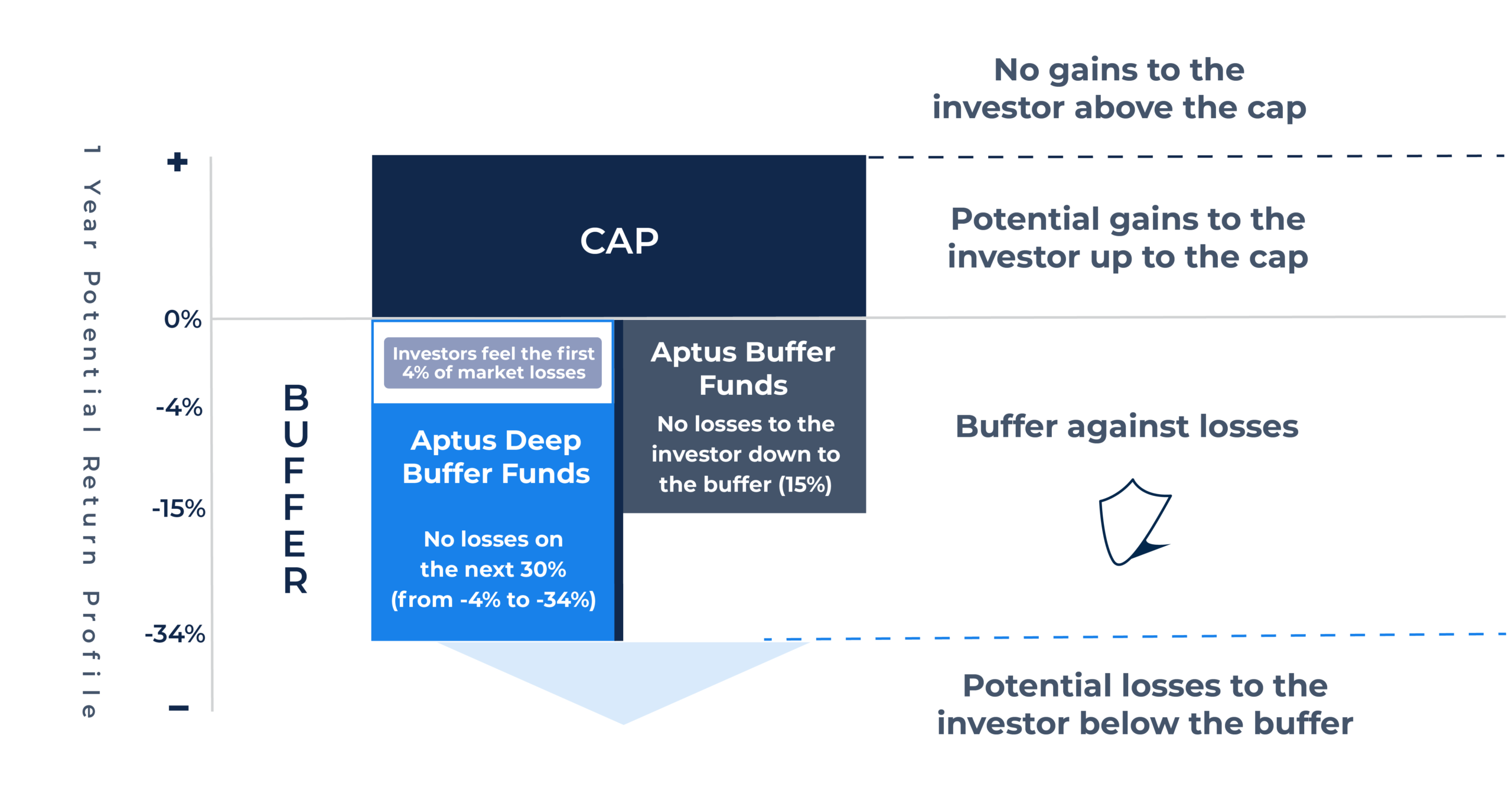
Buffered funds have characteristics unlike many other traditional investment products and may not be suitable for all investors.
*Aptus Buffer Funds reset periodically, every 12 months, defining the buffer and cap for that specific year as stated by each fund’s strategy.
For illustrative purposes only. There is no guarantee that the downside protection sought by a buffer or floor will be successful.
The Suite
JANB
APRB
JULB
OCTB
JADB
APDB
JUDB
OCDB
Laddered Funds
ABUF
ALDB
Outcome Period Data
Current as of 10/15/2026
Ticker |
Name |
Reference Asset |
Fund Price |
Fund Return |
Reference Asset Return |
Return Difference |
Reference Asset Return to Cap |
Remaining Cap |
Remaining Buffer |
Downside Before Buffer |
Remaining Outcome Period |
Max NAV |
|||||||
15% Buffers |
|||||||||||||||||||
JANB |
Aptus January Buffer ETF | SPY | $28.25 | 9.79% | 12.34% | -2.55% | 1.52% | 3.19% | 13.99% | -10.35% | 76 | $29.15 | |||||||
APRB |
Aptus April Buffer ETF | SPY | $27.70 | 11.51% | 22.12% | -10.61% | -4.53% | 3.88% | 18.27% | -12.13% | 166 | $28.77 | |||||||
JULB |
Aptus July Buffer ETF | SPY | $28.38 | 3.46% | 4.16% | -0.69% | 11.33% | 11.35% | 14.25% | -4.14% | 257 | $31.60 | |||||||
OCTB |
Aptus October Buffer ETF | SPY | $28.43 | 0.89% | 0.99% | -0.11% | 15.84% | 15.22% | 14.21% | -1.63% | 349 | $32.76 | |||||||
30% Buffers |
|||||||||||||||||||
JADB |
Aptus January Deep Buffer ETF | SPY | $26.49 | 4.83% | 6.63% | -1.81% | 2.70% | 3.83% | 29.45% | -9.38% | 76 | $27.51 | |||||||
APDB |
Aptus April Deep Buffer ETF | SPY | $26.39 | 4.43% | 6.63% | -2.20% | 5.17% | 6.70% | 29.39% | -9.05% | 166 | $28.16 | |||||||
JUDB |
Aptus July Deep Buffer ETF | SPY | $26.48 | 2.83% | 4.16% | -1.32% | 9.69% | 10.37% | 29.32% | -7.51% | 257 | $29.23 | |||||||
OCDB |
Aptus October Deep Buffer ETF | SPY | $26.73 | 0.75% | 0.99% | -0.24% | 14.55% | 14.08% | 29.26% | -5.49% | 349 | $30.49 | |||||||
Full standardized performance figures can be viewed at each of the following respective fund pages:
https://aptusetfs.com/janb/
https://aptusetfs.com/aprb/
https://aptusetfs.com/julb/
https://aptusetfs.com/octb/
https://aptusetfs.com/jadb/
https://aptusetfs.com/apdb/
https://aptusetfs.com/judb/
https://aptusetfs.com/ocdb/
Market Price: The current price at which shares are bought and sold. Market returns are based upon the last trade price. NAV: The dollar value of a single share, based on the value of the underlying assets of the fund minus its liabilities, divided by the number of shares outstanding. Calculated at the end of each business day. The reference asset is the underlying security or index in which the fund’s FLEX option reference. A return is the gain or loss that an investment generates over time. Return difference is the difference between the fund’s return and reference asset return. The cap is the maximum potential return if held to the end of the current outcome period. Downside before buffer is the amount of Fund loss incurred before the buffer begins. An outcome period is the intended length of time over which the defined outcomes are sought.
FLEX Options Correlation Risk. The FLEX Options held by the Fund will be exercisable at the strike price only on their expiration date. Prior to the expiration date, the value of the FLEX Options will be determined based upon market quotations or using other recognized pricing methods. The value of the FLEX Options prior to the expiration date may vary because of related factors other than the share price of the Underlying ETF. Factors that may influence the value of the FLEX Options, other than changes in the share price of the Underlying ETF, may include interest rate changes, changing supply and demand, decreased liquidity of the FLEX Options, and changing volatility levels of the Underlying ETF.
FLEX Options Liquidity Risk. The FLEX Options are listed on an exchange; however, no one can guarantee that a liquid secondary trading market will exist for the FLEX Options. In the event that trading in the FLEX Options is limited or absent, the value of the Fund’s FLEX Options may decrease.
FLEX Options Valuation Risk. The value of the FLEX Options will be determined based upon market quotations or using other recognized pricing methods. The value of the FLEX Options prior to the expiration date may vary because of related factors other than the value of the Underlying ETF.
Cumulative return is the aggregate amount that an investment has gained or lost over time. Annualized Return is the average return gained or lost by an investment each year over a given time period. Performance is annualized for periods greater than 1 year.
Performance quoted represents past performance, which is no guarantee of future results. Investment return and principal value will fluctuate, so you may have a gain or loss when shares are sold. Current performance may be higher or lower than that quoted. Short-term performance in particular is not a good indication of the fund’s future performance and an investment should not be made solely on returns.
A Buffer Fund will not terminate after the conclusion of the Investment Period. After the conclusion of an Investment Period with respect to a Fund, another will begin. There is no guarantee that the structured outcomes for an Investment Period will be realized.
The structured outcomes of a Buffer Fund may only be realized if you are holding shares on the first day of an Investment Period and continue to hold them on the last day of that Investment Period. If you purchase shares after an Investment Period has begun or sell shares prior to an Investment Period’s conclusion, you may experience investment returns very different from those that the Fund seeks to provide. If the Investment Period has begun and the Fund has increased in value to a level near to the Cap (as defined below), an investor purchasing at that price has little or no ability to achieve gains but remains vulnerable to downside risks. Similarly, if the Investment Period has begun and the Fund has decreased in value beyond the pre-determined buffer (as described below), an investor purchasing shares at that price may not benefit from the buffer. There is no guarantee that a Fund will successfully achieve its investment objective.
Fund shareholders are subject to an upside return cap (the “Cap”) that represents the maximum percentage return an investor can achieve from an investment in a Fund for an Investment Period. Therefore, even though the Funds’ returns are based upon the Underlying ETF, if the Underlying ETF experiences returns for an Investment Period in excess of the Cap, you will not experience those excess gains. A Fund’s Cap may rise or fall from one Investment Period to the next. There is no guarantee that a Fund’s Cap will remain the same upon the conclusion of its Investment Period.
Buffered Loss Risk. There can be no guarantee that the Fund will be successful in its strategy to buffer against Underlying ETF losses if the Underlying ETFs share price decreases by 15% or less over the duration of the Investment Period. Despite the intended Buffer, a shareholder could lose their entire investment.
Deep Buffered Loss Risk. There can be no guarantee that the Fund will be successful in its strategy to buffer against Underlying ETF losses if the Underlying ETFs share price decreases by 30% or less over the duration of the Investment Period. Despite the intended Buffer, a shareholder could lose their entire investment.
Capped Upside Risk. The Fund’s strategy seeks to provide returns that match those of the Underlying ETF for Shares purchased on the first day of an Investment Period and held for the entire Investment Period, subject to a pre-determined upside Cap. If an investor does not hold its Shares for an entire Investment Period, the returns realized by that investor may not match those the Fund seeks to achieve.